Permissions & RBAC
OpsDeck implements a module-level role-based access control system with group inheritance and in-memory caching.
Permission model
Permissions are defined per module (assets, compliance, risk, etc.) with two access levels:
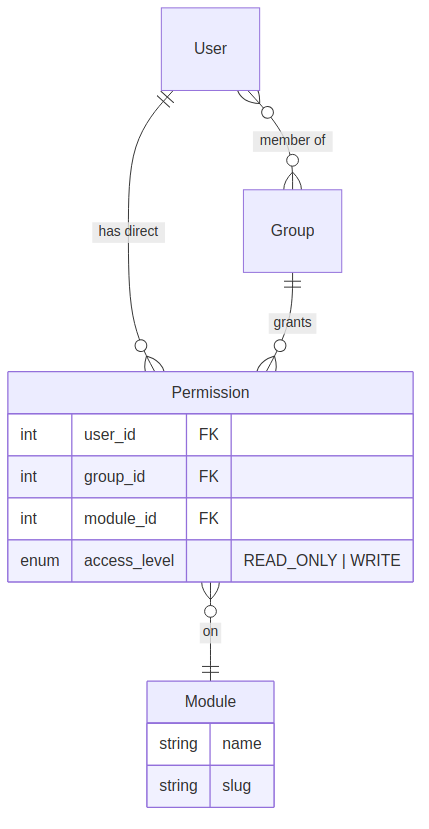
The AccessLevel enum has two values:
| Level | Grants |
|---|---|
READ_ONLY |
View access to module data |
WRITE |
Create, update, and delete access (implies read) |
Resolution algorithm
When a request hits a @permission_required(module, level) decorator:
- Check the permission cache for the user.
- If not cached, resolve permissions:
- Load direct permissions (
Permissionrecords whereuser_idmatches). - Load group permissions (from all groups the user belongs to).
- Merge: for each module, take the highest access level (WRITE > READ_ONLY).
- Load direct permissions (
- Cache the resolved permission map.
- Check if the user has the required level on the requested module.
Group-based permissions
Groups simplify permission management for teams:
- Create a group (e.g., "IT Operations," "Compliance Team").
- Assign module permissions to the group.
- Add users as members.
- All members inherit the group's permissions.
When a user belongs to multiple groups, permissions are merged — the highest level wins.
Permission caching
The PermissionsCache is a singleton in-memory dictionary:
- Key: user ID.
- Value: dict mapping module slugs to access level names.
- Invalidation: triggered when group membership or role assignment changes (calling
permissions_cache.invalidate(user_id)orpermissions_cache.invalidate()for global clear).
This avoids repeated database queries for permission checks on every request. The cache lives in the application process — in multi-worker deployments, each worker maintains its own cache.
Admin bypass
Users with the Admin role bypass all permission checks. Admin status is checked before the permission resolution chain runs.
API permissions
API tokens inherit the owning user's permissions. The check_token() before-request hook resolves the user from the token and applies the same RBAC checks.